Table of Contents
CPI-C IO Features
Rear Panel IO
The CPi-C series panel PCs have a 26-pin header socket on the rear panel with the following pinout.
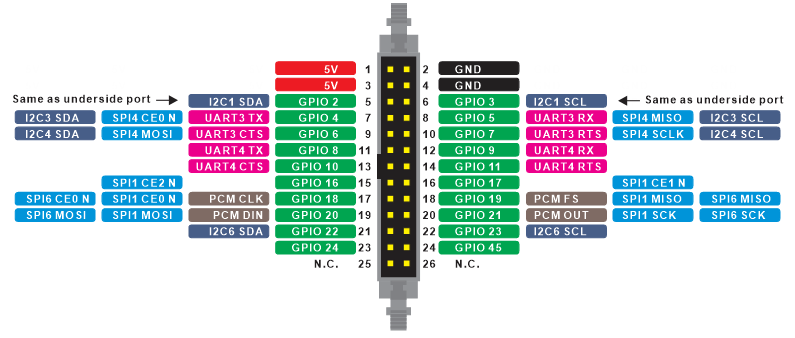 See pp.8 of the Compute Module 4 datasheet for more information.
The GPIO pins are not exposed through a level shifter like the CPi-S panel PCs, so the internal pull-up/-down resistors can be utilized. GPIO45 has an internal 1.8kohm pullup resistor to 3.3V because it is initially used for I2C (See Table 6 of the Compute Module 4 datasheet).
The 5V pins can supply a maximum current of 1A. The 3.3V pins can supply a maximum current of 700mA. If both 5V and 3.3V rail pins are used simultaneously, their total power should be kept below 5 watts.
The panel PC's RTC is connected to I2C1, so those pins assigned to I2C1 should not be reconfigured.
Underside IO
The underside of the CPi-C panel PCs expose 12~24VDC power input, 1 RS-232 serial port, 1 RS-485 serial port, 3 USB 2.0 ports, an I2C port, 5V power output, and an RJ45 Ethernet port.

Please note that the I2C pins (SDA and SCL) are 3.3V; the 5V pin is supplied to ensure users have enough voltage and current to power their external devices and does not imply a 5V I2C port.
The USB device port dedicated to programming the Compute Module's eMMC.
Side Panel IO
The right panel of the CPi-C panel PCs exposes a MicroSD card slot and a stereo audio output jack.

For models with an eMMC, the MicroSD card slot is not electrically connected, so it cannot be used.