PCB Design Guidelines
Noise control does not start after the PCB is finished. It starts during the design stage.
A few simple design habits can prevent many noise-related problems later.
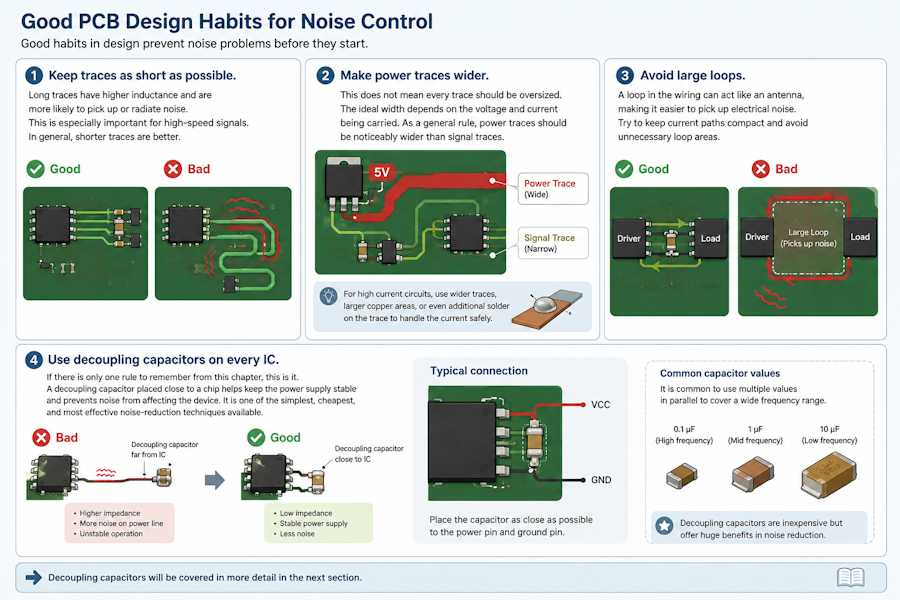
Keep traces as short as possible.
Long traces have higher inductance and are more likely to pick up or radiate noise. This becomes especially important for high-speed signals. In general, shorter traces are better.
Make power traces wider.
This does not mean every trace should be oversized. The ideal width depends on the voltage and current being carried. As a general rule, power traces should be noticeably wider than signal traces.
For circuits carrying high current, extra attention is required. Wider traces, larger copper areas, or even additional solder on the trace may be necessary to handle the current safely.
Avoid large loops.
A loop in the wiring can act like an antenna, making it easier to pick up electrical noise. Try to keep current paths compact and avoid unnecessary loop areas.
Use decoupling capacitors on every IC.
If there is only one rule to remember from this chapter, this is it.
A decoupling capacitor placed close to a chip helps keep the power supply stable and prevents noise from affecting the device. It is one of the simplest, cheapest, and most effective noise-reduction techniques available.
We'll take a closer look at decoupling capacitors in the next section.