Varistors (MOVs)
A varistor is a protective component whose resistance changes depending on the applied voltage. Under normal operating conditions, it has very high resistance and allows almost no current to flow through it. However, when the voltage suddenly rises above a certain level, its resistance drops dramatically.
Because of this behavior, a varistor is typically connected in parallel with the circuit being protected. If a large voltage spike occurs, the varistor provides an easier path for the excess current, helping to keep the surge away from sensitive components.
Varistors are particularly effective at absorbing surge energy, such as voltage spikes caused by lightning, large motors, relays, or power-line disturbances.
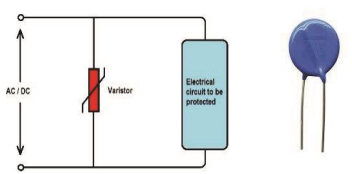
At first glance, a varistor and a TVS diode may seem to do the same job. Both are used to protect circuits from excessive voltage. However, varistors have a relatively large capacitance, which can affect high-speed signals. In communication circuits or other high-speed signal lines, a varistor may distort the signal and reduce communication reliability.
For this reason, TVS diodes are usually preferred for protecting high-speed communication interfaces, while varistors are commonly used on power lines and other circuits where signal speed is not critical.
Varistors are generally less expensive than TVS diodes, so choosing between the two depends on the application. Understanding the type of signal and the level of protection required will help you select the most appropriate device.